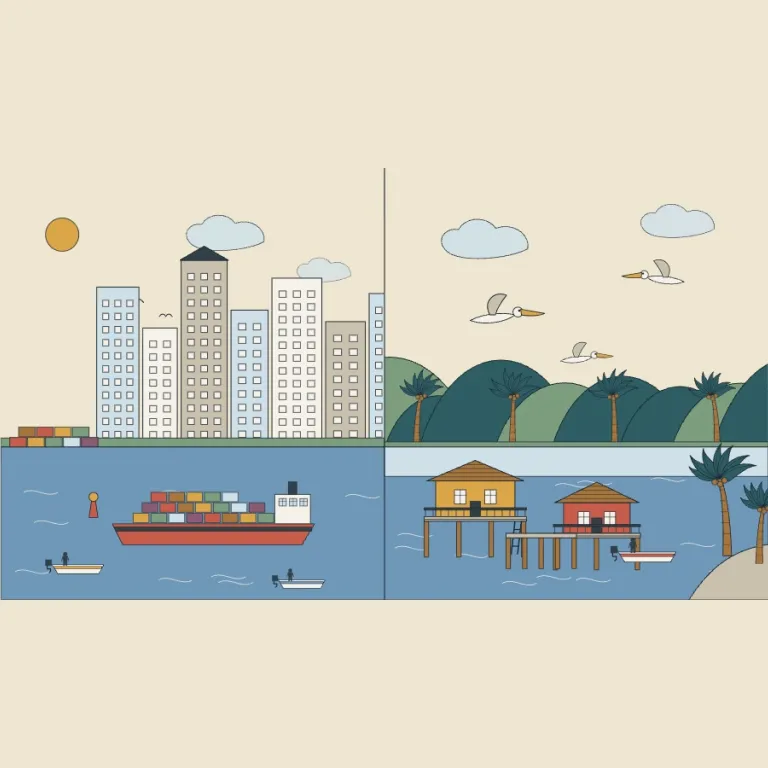
The best time to visit Panama is mid-December to mid-April, the dry season on the Pacific side and in Panama City, where February averages just 0.4 in (9 mm) of rain across 2.4 rainy days. Avoid October and November if your trip is built around the capital, the canal and the Pacific beaches: Panama City takes 11.1 in (282 mm) in November alone. The Caribbean coast runs on its own calendar, and Panama sits below the hurricane belt, so no month here carries storm risk. Month-by-month numbers, prices, crowds and where to stay in each season are below, on MyPanamaStay.
The short answer
- Best overall: mid-December to mid-April. Dry season on the Pacific, the canal watershed and the whole capital region. February is the driest month in Panama City at 0.4 in (9 mm).
- Best for the Caribbean: February to March, then September to mid-October. Bocas del Toro is wettest in November at 15.7 in (400 mm), not in the middle of the Pacific rainy season.
- Best for humpback whales: July to October, on the Pacific side only, around the Pearl Islands and the Gulf of Chiriquí.
- Worst stretch on the Pacific: October and November. Panama City logs 29.9 and 27.8 rainy days in those two months.
- Cheapest: the green season, May to November, when rates and demand both drop outside the November holiday block.
- Sea temperature: 82 to 85 F (27.7 to 29.7 C) off Bocas del Toro every month of the year. There is no cold month in the water.
- No hurricanes. Panama lies between roughly 7 and 9 degrees north, below the belt where Atlantic tropical cyclones form and track.
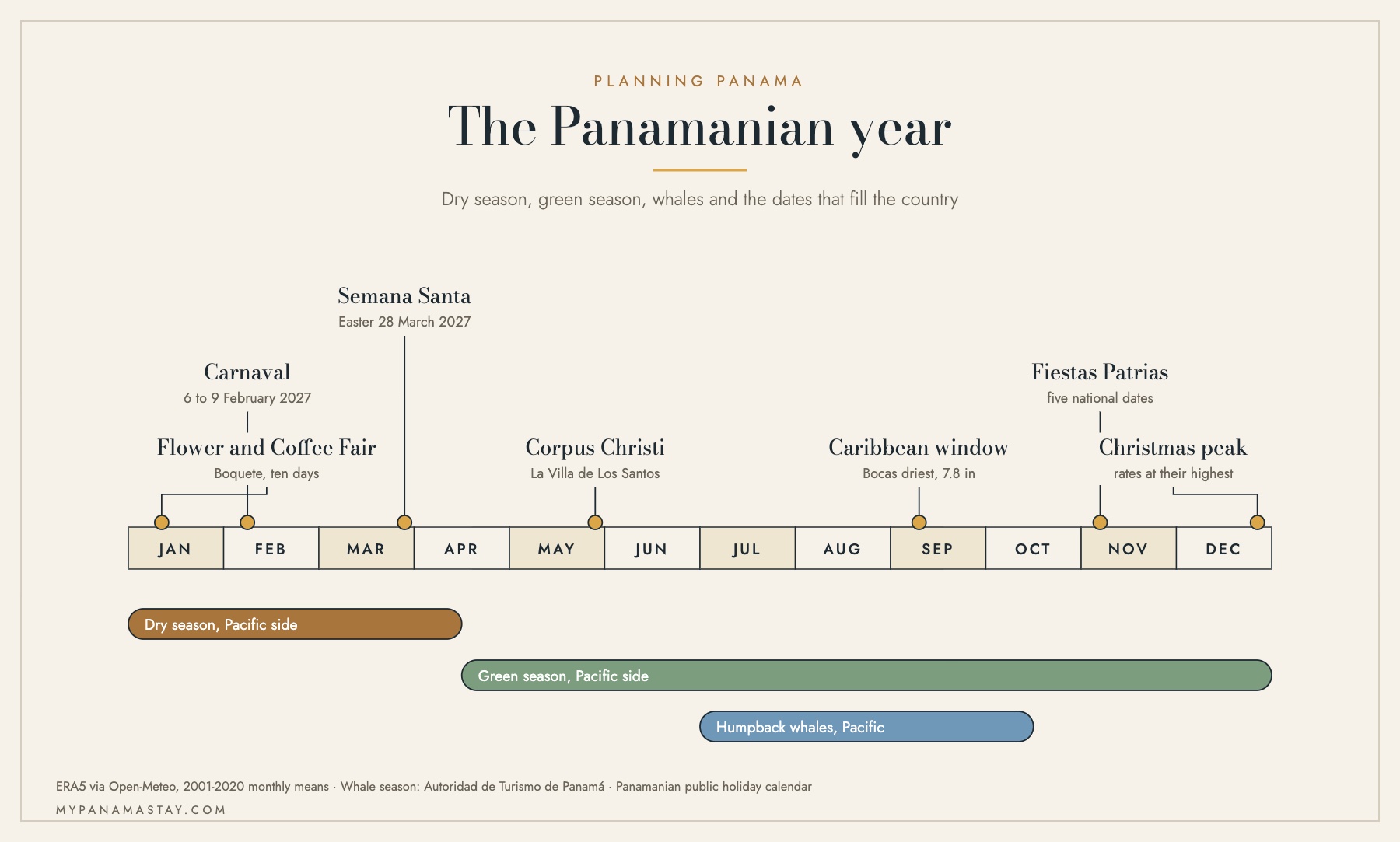
The Panamanian year at a glance. The bands are the Pacific side; the Caribbean coast runs on its own schedule.
Understanding Panama's climate: two coasts, one country
Panama is only about 50 miles (80 km) wide at the canal, and that narrowness is the single most useful fact for planning a trip. The country has no four seasons. It has a dry season, called verano locally, and a rainy season, called invierno, and the two coasts do not observe them at the same time. The mountain spine running down the middle catches the Caribbean trade winds, dumps their moisture on the northern slope, and leaves the Pacific side in a rain shadow for four months of the year.
The monthly figures used throughout this page come from the ERA5 reanalysis (ECMWF) via Open-Meteo, monthly means 2001 to 2020, for three stations that represent the three faces of Panama: Panama City on the Pacific, Bocas del Toro on the Caribbean, and Boquete at altitude in Chiriquí. Sea temperature comes from NOAA OISST, 2016 to 2025 averages, at a point off Bocas del Toro. A rainy day here means a day with 1 mm or more, the same definition for all three stations.
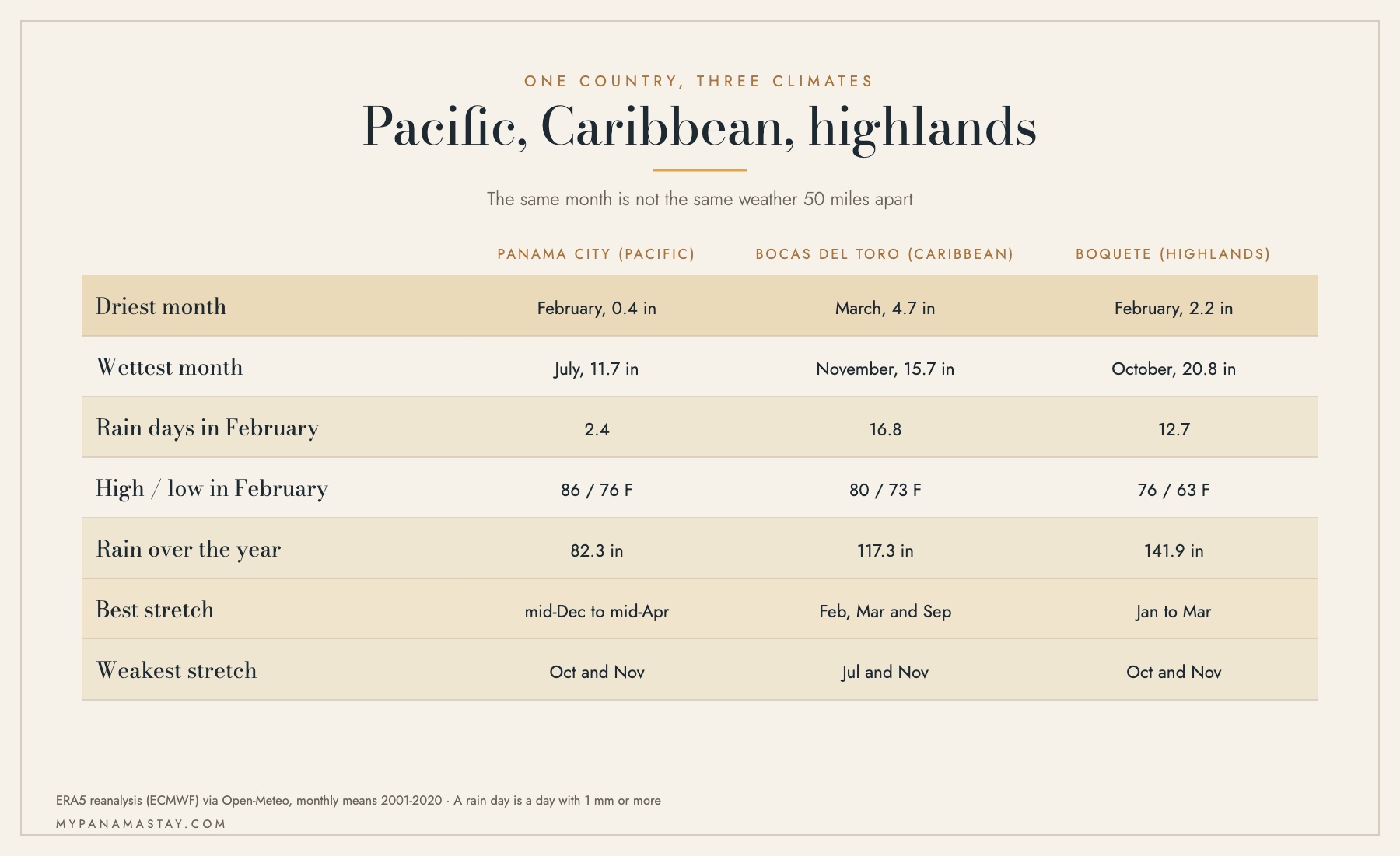
Panama City takes 0.4 in of rain in February. Bocas del Toro, 50 miles away across the mountains, takes 4.8 in.
The Pacific side and Panama City
Panama City, Playa Blanca, Pedasí, Santa Catalina and the Azuero Peninsula all sit on the Pacific, and all get a genuine dry season. January, February and March together bring 1.6 in (41 mm) of rain to Panama City, spread over 11.3 rainy days in three months. From May onward the pattern inverts: July is the wettest month at 11.7 in (298 mm) and 30.1 rainy days, which in practice means rain on essentially every day.
Temperatures barely move. Panama City runs a high of 83 to 87 F (28.2 to 30.8 C) and a low of 75 to 76 F (24.0 to 24.7 C) in every month of the year. The difference between January and July is not heat, it is water and light. Humidity and cloud cover are what change.
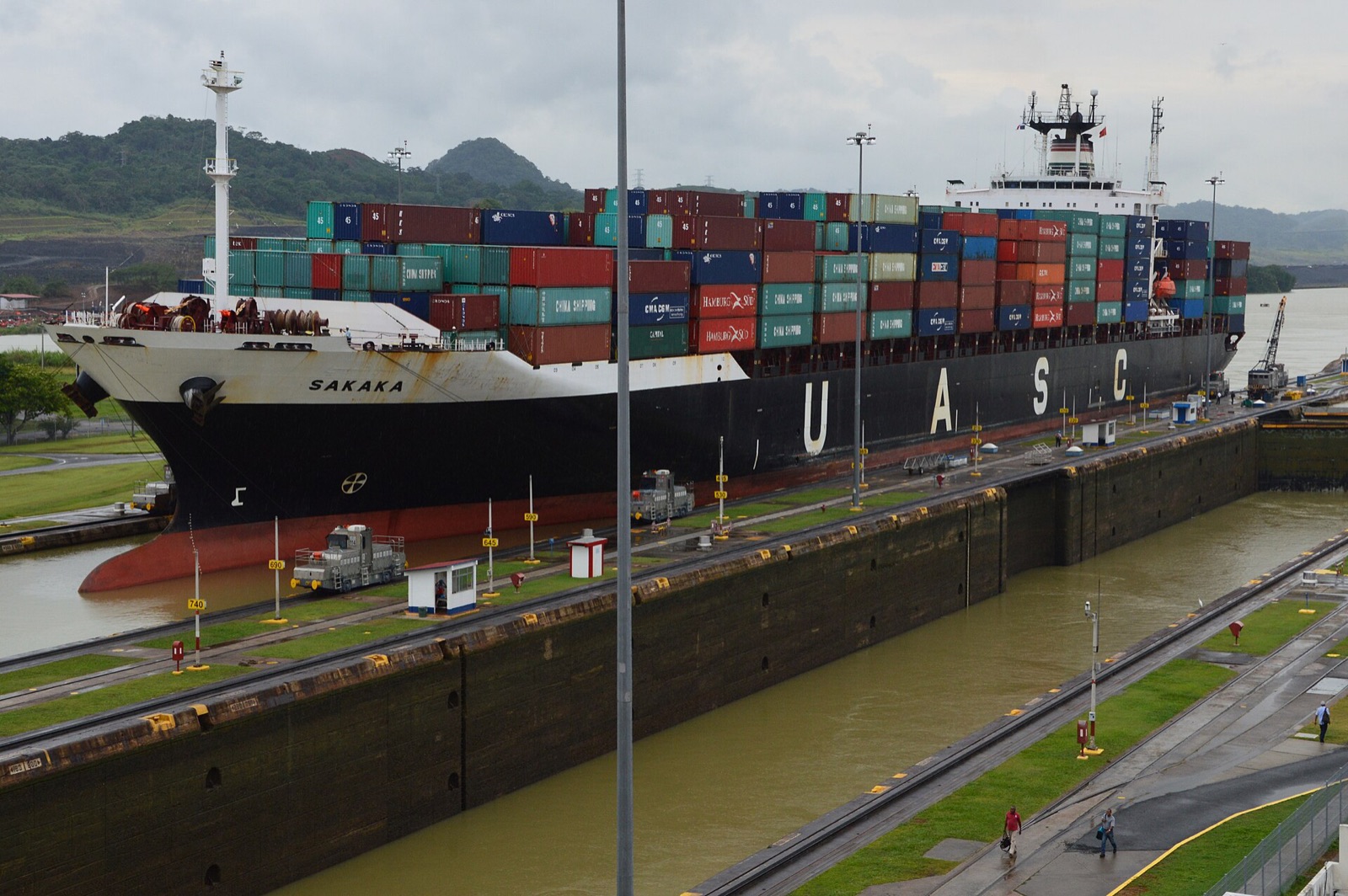
The Miraflores Locks on the Panama Canal, Panama City. Photo : Ivo Kruusamägi, Wikimedia Commons, CC BY-SA 4.0.

The Caribbean side and Bocas del Toro
Bocas del Toro, Guna Yala and the Colón coast follow a different rhythm, and this is where most trip planning goes wrong. Bocas del Toro gets 117.3 in (2,980 mm) of rain a year against 82.3 in (2,090 mm) in Panama City, but the shape of the year is not the same. Its wettest month is November at 15.7 in (400 mm), and its driest are March at 4.7 in (120 mm) and February at 4.8 in (121 mm).
Compare the same three months on both sides and the split is stark: 41 mm in Panama City from January to March, 451 mm in Bocas del Toro. There is also a second, shorter dry window on the Caribbean around September, when Bocas falls to 7.8 in (197 mm) while the Pacific is at its soggiest. That September window is the reason a Caribbean-first trip can work in a month most guides tell you to avoid.
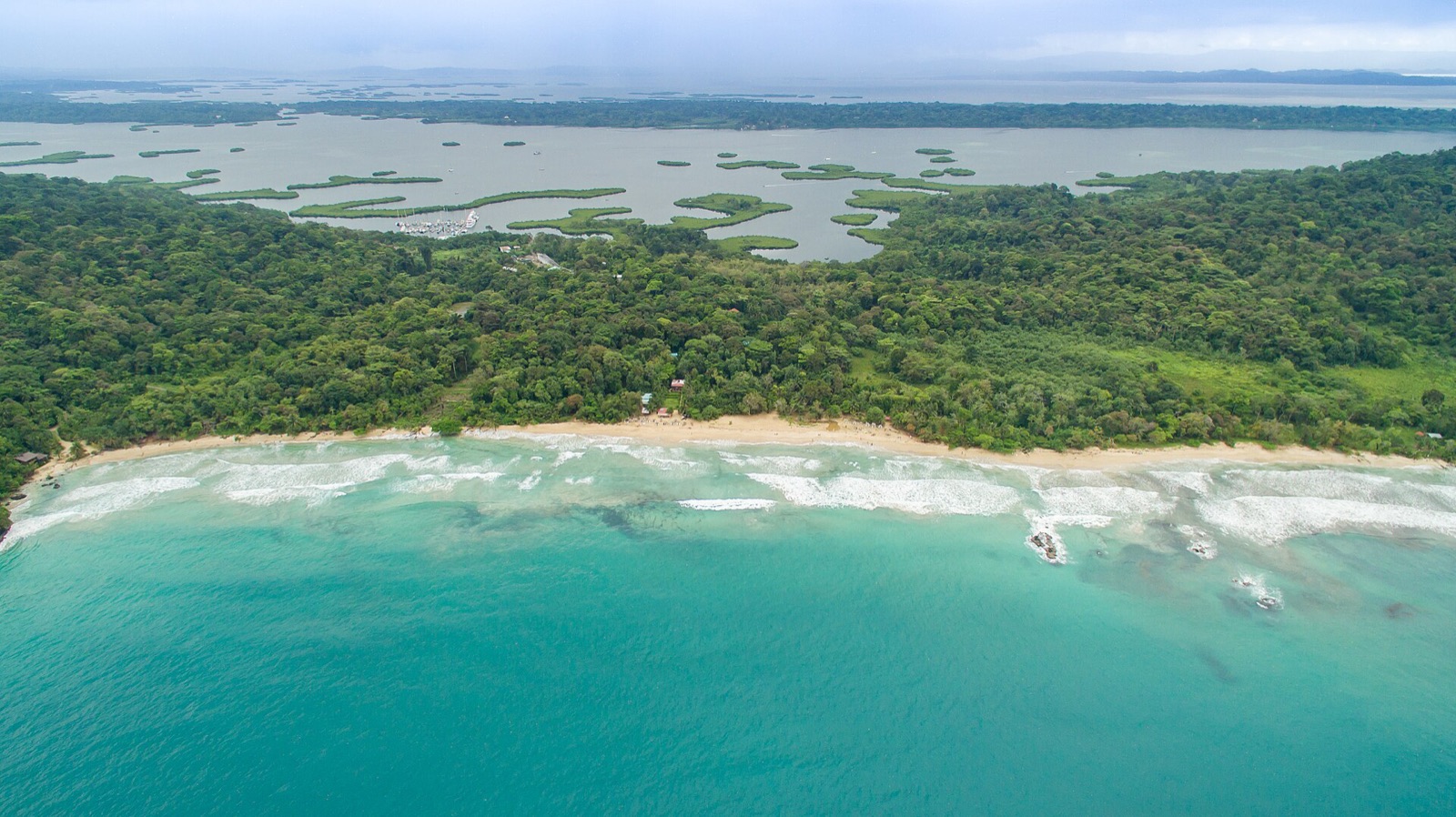
Red Frog Beach, Isla Bastimentos, in the Bocas del Toro archipelago. Photo : dronepicr, Wikimedia Commons, CC BY 2.0.
.jpg)
The highlands: Boquete, Volcán and El Valle
Above roughly 3,300 ft (1,000 m) the arithmetic changes again. Boquete, in Chiriquí province at the foot of Volcán Barú, holds highs of 74 to 77 F (23.1 to 25.2 C) and lows of 63 to 66 F (17.1 to 18.9 C) all year. That is sweater weather at night, every month, about 20 F cooler than the coast.
It is also the wettest of the three stations: 141.9 in (3,603 mm) a year, peaking in October at 20.8 in (528 mm). The dry window is short and sharp. February takes 2.2 in (56 mm) over 12.7 rainy days, which is when the coffee harvest finishes and the town holds its flower and coffee fair.
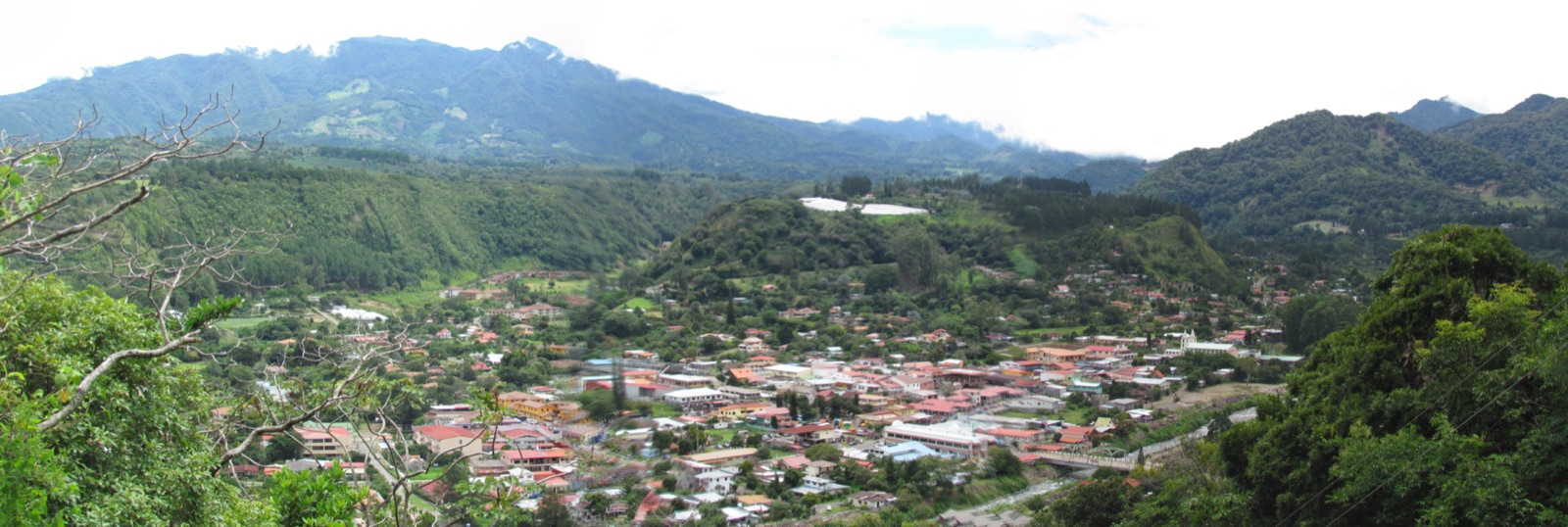
Boquete, in the Chiriqui highlands, where highs stay between 74 and 77 F all year. Photo : Dr. Ariel Rodríguez-Vargas, Wikimedia Commons, CC BY-SA 4.0.
The dry season: mid-December to mid-April
This is the high season, and it earns the name. Skies over Panama City are clear for most of the day, the trade winds blow steadily, and the Pacific beaches from Playa Blanca to Pedasí are at their calmest. February and March are the two driest months of the year on the Pacific side.
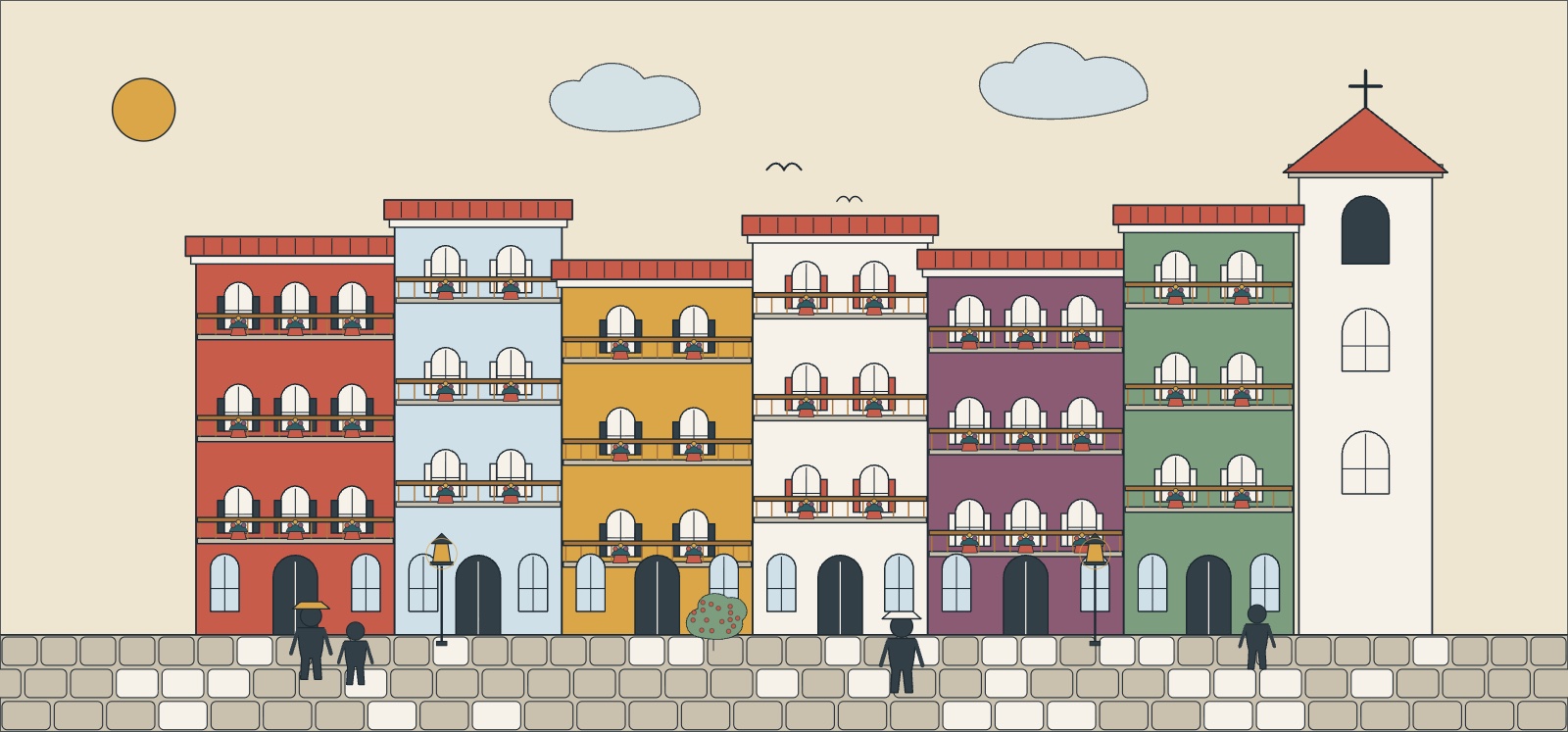
Casco Viejo is a walking quarter, which is why the dry season suits it so well. Illustration : Explore the Best Luxury Hotel Deals in Panama.
What the dry season does well:
- Panama City sightseeing. Casco Viejo on foot, the Miraflores and Agua Clara locks, the Amador Causeway and the Biomuseo are all outdoor-dependent and all better in February than in October.
- Pacific beaches and boat days. The sea off the Pearl Islands and the Gulf of Chiriquí is flattest between January and March.
- The Volcán Barú summit hike. The pre-dawn climb to 11,398 ft (3,475 m) is worth doing only in clear weather, which means the January to March window.
- Birding on Pipeline Road and in Soberanía National Park, where trails are passable and light is good.
- Guna Yala island hopping, where dry-season sea conditions make the open-boat crossings comfortable.
What to plan around:
- Wind. The dry season is also the windy season on the Pacific. December through February can bring stiff afternoon breezes that chop up the water and cancel small-boat trips at short notice.
- Crowds and rates peak twice, at Christmas and New Year, then again over Carnival and Holy Week. Book Casco Viejo and Bocas del Toro several months ahead for those two blocks.
- It is still hot. March is the hottest month in Panama City at 87 F (30.8 C), with the same 76 F (24.4 C) nights as every other month.
- Water rationing occasionally affects the drier Azuero Peninsula at the end of a long dry season, in March and April.
The green season: mid-April to mid-December
Panamanians call it invierno, winter, and the name misleads visitors. The temperature does not drop. What changes is the shape of the day: mornings are usually bright, cloud builds through midday, and the rain arrives in the afternoon as a heavy burst rather than a steady drizzle. Panama City still records 30.1 rainy days in July, so the rain is daily, but it is not all day.
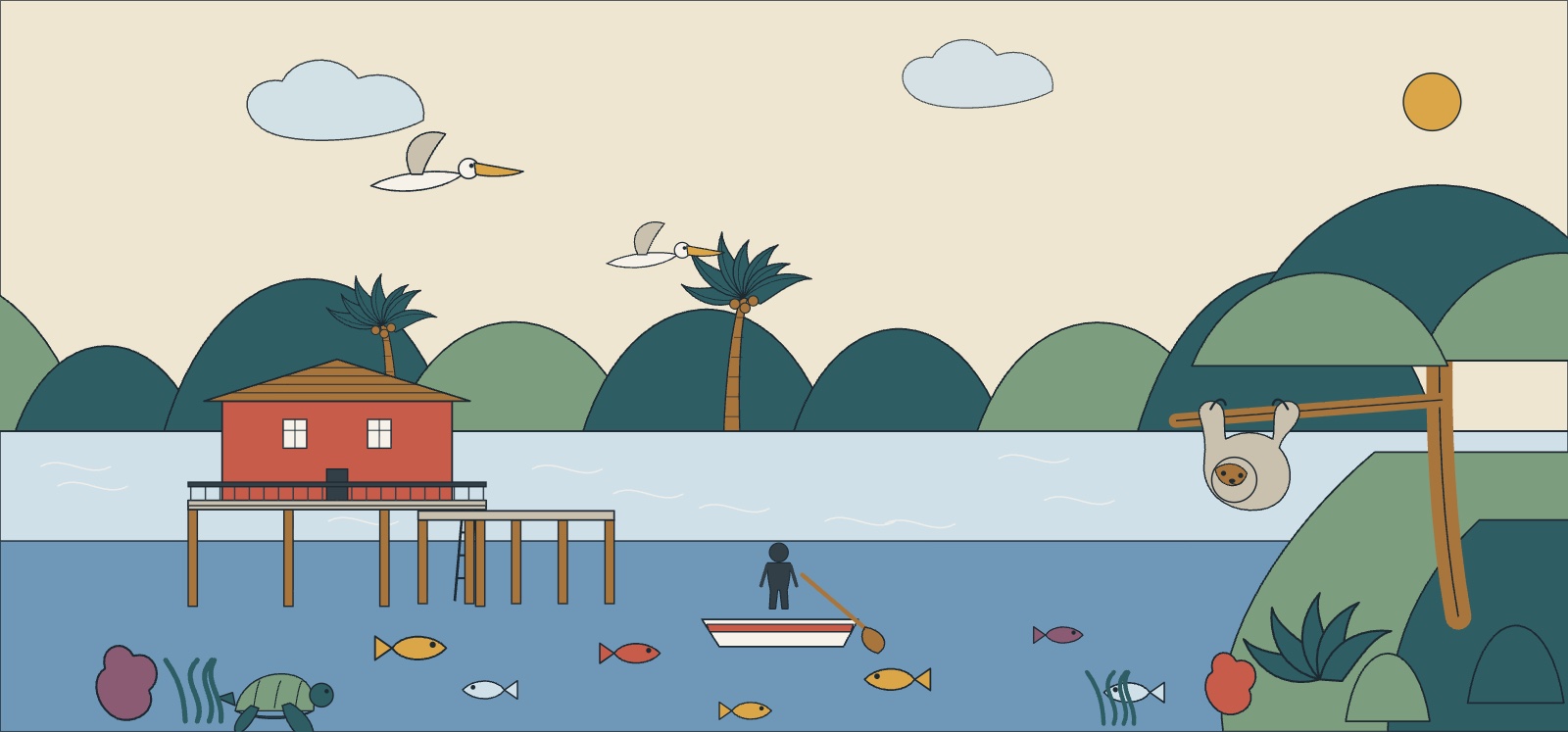
Bocas del Toro in the green season: the Caribbean archipelago keeps its own dry windows, in February, March and September. Illustration : Explore the Best Luxury Hotel Deals in Panama.
The case for going anyway:
- Rates fall. The green season is the cheapest stretch of the year to fly in and to book a room, with the November holiday block as the exception.
- The rainforest is at its best. Waterfalls in El Valle de Antón and around Boquete run full, and the canopy is loud.
- Humpback whales arrive on the Pacific in July and stay into October.
- Surf season on the Pacific. Santa Catalina and Playa Venao take their biggest swells from April to October.
- Space. Casco Viejo restaurants, Bocas water taxis and Guna Yala cabins are all easier to get in September than in February.
The precautions that matter:
- Plan mornings, not afternoons. Book the canal visit, the hike and the boat trip before noon and treat the afternoon as flexible.
- Roads flood. The Chiriquí highlands and the Bocas mainland road are the two places where landslides and washouts close routes during heavy rain, most often in October and November.
- Domestic flights cancel more often in the wet months than the schedule suggests. Leave a buffer day before an international departure.
- October and November are the two weakest months on the Pacific, with 29.9 and 27.8 rainy days in Panama City. If those are your only dates, go Caribbean or highland rather than Pacific.
- Mosquitoes. Dengue transmission tracks the rains; repellent matters more from June to November than in February.
Panama month by month
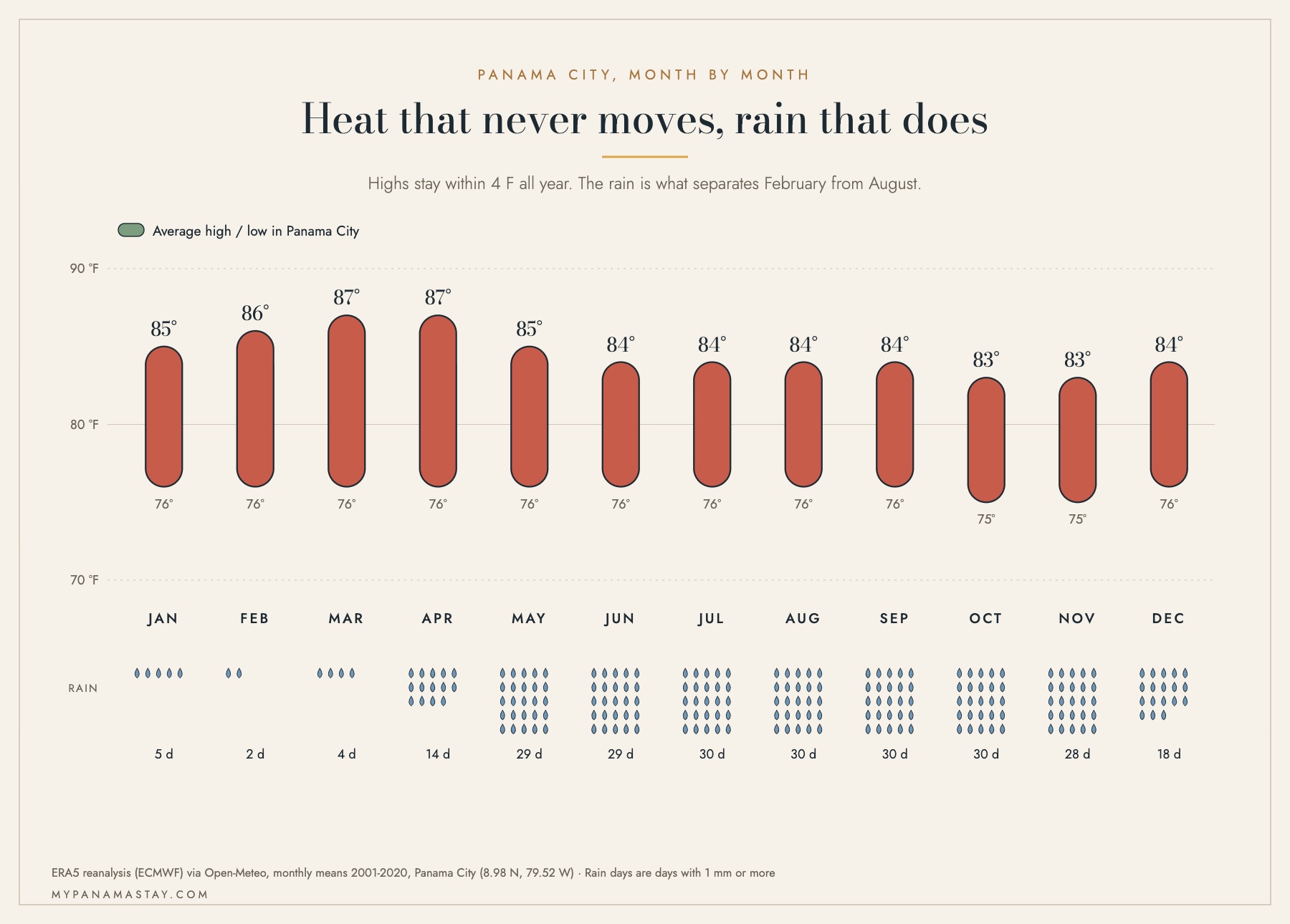
Panama City month by month. The temperature barely moves; the rain moves everything.
| Month | Panama City high / low | Panama City rain | Bocas del Toro rain | Caribbean sea | Verdict |
|---|---|---|---|---|---|
| January | 85 / 76 F (29 / 24 C) | 0.7 in (19 mm), 4.7 days | 8.3 in (210 mm), 20.5 days | 82 F (27.9 C) | Dry, bright, busy |
| February | 86 / 76 F (30 / 24 C) | 0.4 in (9 mm), 2.4 days | 4.8 in (121 mm), 16.8 days | 82 F (27.7 C) | Driest, best overall |
| March | 87 / 76 F (31 / 24 C) | 0.5 in (13 mm), 4.2 days | 4.7 in (120 mm), 19.0 days | 83 F (28.1 C) | Dry, hot, excellent |
| April | 87 / 76 F (31 / 25 C) | 3.2 in (82 mm), 14.4 days | 5.2 in (132 mm), 20.1 days | 83 F (28.5 C) | Turning, still good |
| May | 85 / 76 F (29 / 25 C) | 9.1 in (230 mm), 28.9 days | 11.3 in (287 mm), 25.9 days | 85 F (29.2 C) | Green season starts |
| June | 84 / 76 F (29 / 24 C) | 9.9 in (251 mm), 29.2 days | 11.1 in (282 mm), 28.2 days | 85 F (29.3 C) | Wet afternoons, quiet |
| July | 84 / 76 F (29 / 24 C) | 11.7 in (298 mm), 30.1 days | 15.0 in (380 mm), 28.9 days | 84 F (28.7 C) | Whales arrive, wet |
| August | 84 / 76 F (29 / 24 C) | 10.8 in (274 mm), 30.2 days | 10.6 in (270 mm), 28.0 days | 84 F (29.0 C) | Wet, whales peak |
| September | 84 / 76 F (29 / 24 C) | 10.2 in (260 mm), 29.6 days | 7.8 in (197 mm), 26.4 days | 85 F (29.6 C) | Caribbean window opens |
| October | 83 / 75 F (28 / 24 C) | 10.4 in (264 mm), 29.9 days | 10.6 in (269 mm), 27.8 days | 85 F (29.7 C) | Wettest, avoid Pacific |
| November | 83 / 75 F (28 / 24 C) | 11.1 in (282 mm), 27.8 days | 15.7 in (400 mm), 27.0 days | 84 F (29.0 C) | Wet, holidays, crowded |
| December | 84 / 76 F (29 / 24 C) | 4.3 in (108 mm), 17.8 days | 12.3 in (312 mm), 22.7 days | 83 F (28.1 C) | Drying out, festive |
Air temperature and rainfall: ERA5 reanalysis (ECMWF) via Open-Meteo, monthly means 2001 to 2020, for Panama City (8.98 N, 79.52 W) and Bocas del Toro (9.34 N, 82.24 W). A rainy day is a day with 1 mm or more. Sea temperature: NOAA OISST, 2016 to 2025 averages, off Bocas del Toro. Monthly visitor arrivals are not shown because the Autoridad de Turismo de Panamá does not publish an accessible month-by-month series; crowd notes come from the fixed holiday calendar instead.
The best time for what you want to do
See the canal
The Miraflores and Agua Clara visitor centers operate year round, and transits do not stop for weather. The difference is comfort and light. January to March gives you clear skies over the locks and a dry walk along the Amador Causeway afterward. A full or partial transit on a passenger boat is a five to nine hour day on open water, which is markedly better in the dry season.
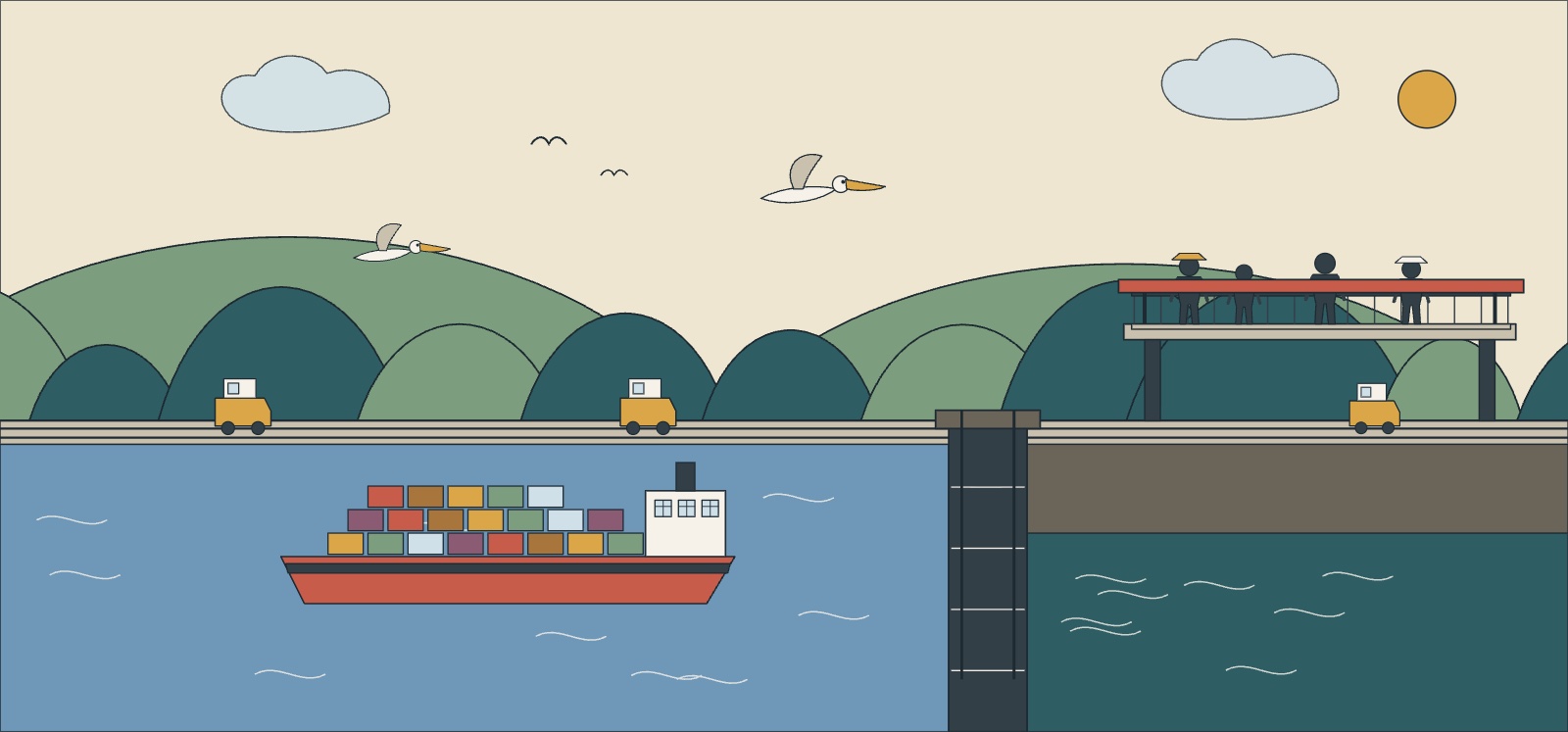
The locks run year round, but January to March is when the viewing platforms stay dry. Illustration : Explore the Best Luxury Hotel Deals in Panama.
Watch humpback whales
July to October, Pacific side only. Southern hemisphere humpbacks migrate north to breed in Panamanian waters, and the Pearl Islands (Archipiélago de Las Perlas) off Panama City are the easiest access point, with the Gulf of Chiriquí and the waters around Coiba National Park the other two centers. The official Panama tourism board places the season between July and September, with sightings running into October. Panama is one of the few places where northern and southern hemisphere humpback populations both appear, which is why the Pacific coast has two, uneven whale windows rather than one. More on the properties that put you on the water: Panama's humpback whale season.
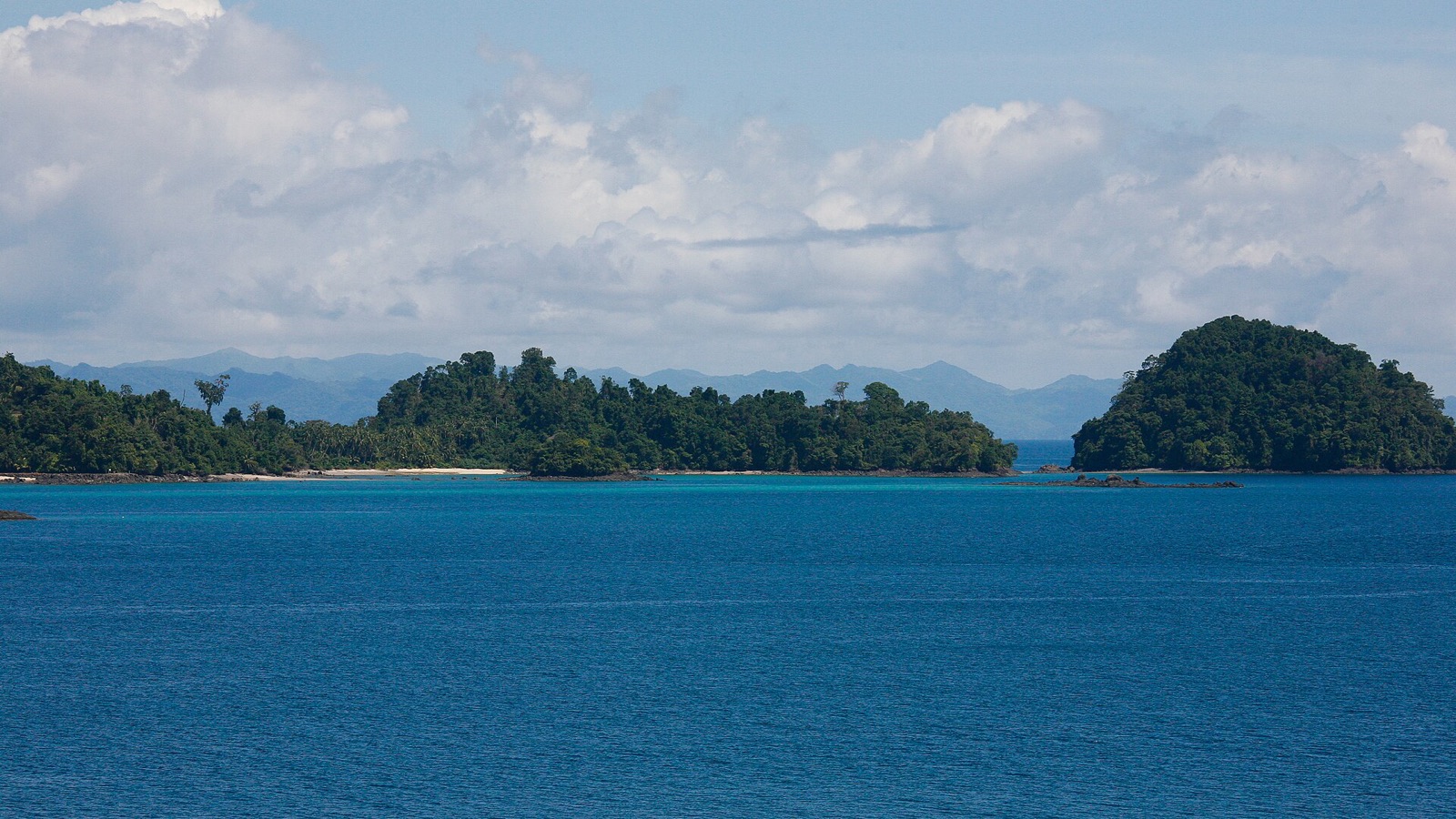
Coiba National Park, on Panama's Pacific coast, one of the centres of the July to October humpback season. Photo : Alex Proimos from Sydney, Australia, Wikimedia Commons, CC BY 2.0.
_(8371374375).jpg)
Dive and snorkel
Coiba National Park and the Gulf of Chiriquí are best from December to April, when Pacific visibility is highest and the sea is flat. On the Caribbean, Bocas del Toro and Guna Yala dive best in February, March and September, matching their local dry windows rather than the national one. See the Gulf of Chiriquí guide and the San Blas archipelago guide.
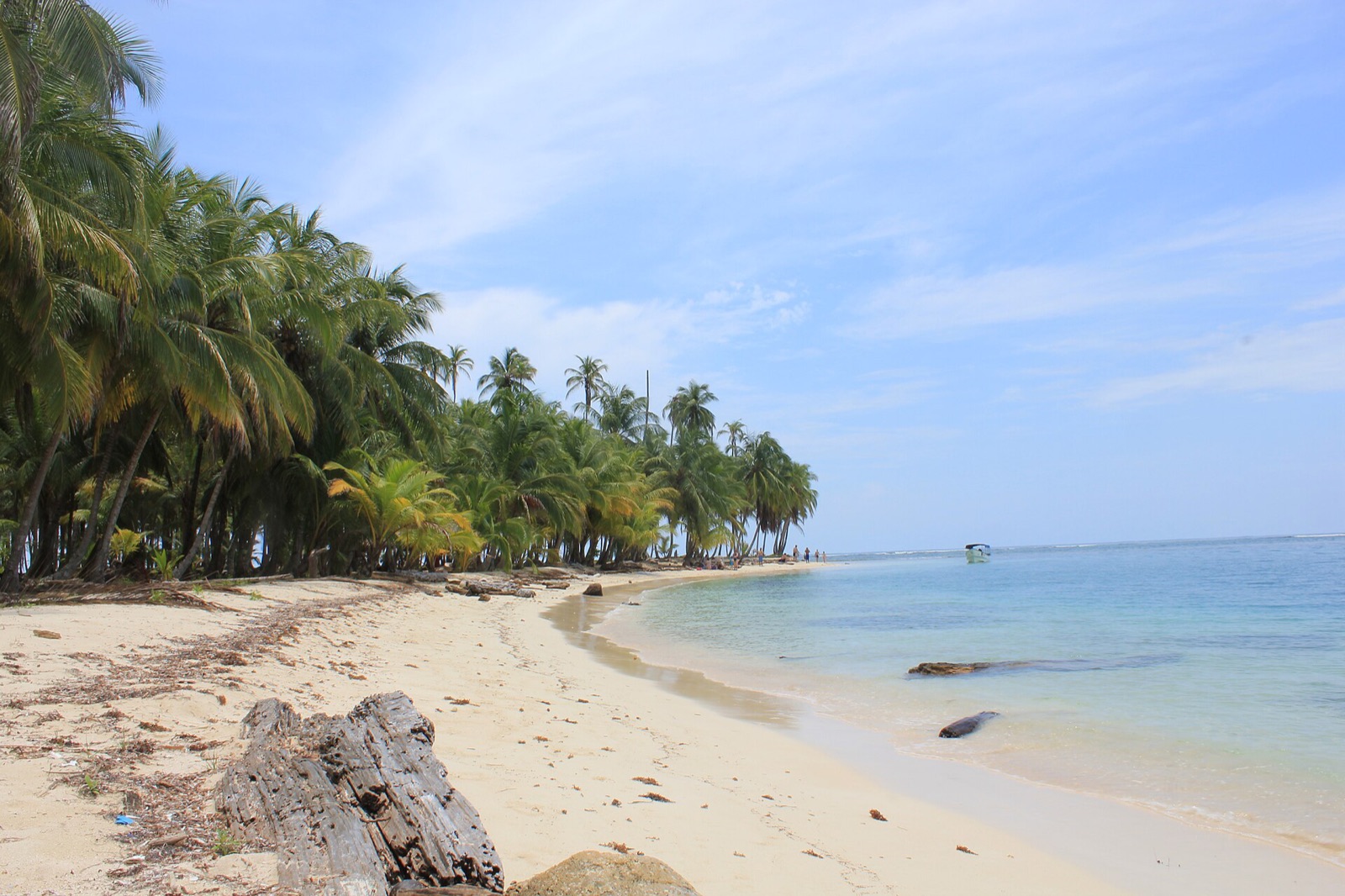
An island in Guna Yala, the Caribbean archipelago also known as San Blas. Photo : Ayaita, Wikimedia Commons, CC BY 3.0.

Surf
April to October on the Pacific. Santa Catalina in Veraguas and Playa Venao on the Azuero Peninsula take the southern swells across those months. On the Caribbean, Bocas del Toro works from December to March, exactly the reverse.
Drink coffee at the source
The Chiriquí harvest runs from roughly October to March, and the estates around Boquete and Volcán are working farms in those months rather than showpieces. February is the overlap of dry weather and late harvest. See Boquete cloud forest lodges.
Travel on a budget
May, June and September are the three best value months: green season rates, no domestic holiday block, and in September a Caribbean coast that is drying out while the Pacific is not. The site's own reading of that window: the September window and green season at Panama's beach hotels.
Events that shape the year
Panama's calendar is unusually concentrated. One month, February, holds the biggest party, and one month, November, holds almost every national holiday the country has.
- January: Feria de las Flores y del Café, Boquete. The flower and coffee fair moved to January decades ago specifically to sit in the dry season. It fills every room in the Chiriquí highlands for about ten days.
- January: Panama Jazz Festival, Panama City. A week of concerts and clinics in the capital, in the driest stretch of the year.
- 6 to 9 February 2027: Carnaval. Four days, a national public holiday, and the single busiest block on the calendar. Las Tablas, on the Azuero Peninsula, runs the most famous version with its two rival tunas; Panama City holds its parade on the Cinta Costera. Everything closes from Saturday to Ash Wednesday.
- 22 to 28 March 2027: Semana Santa. Easter Sunday falls on 28 March in 2027. Panamanians head for the beaches, Pacific coastal hotels sell out, and Thursday and Friday are quiet in the capital.
- Late May 2027: Corpus Christi, La Villa de Los Santos. Held sixty days after Easter, so 27 May in 2027, with the diablicos sucios devil dancers in the Azuero Peninsula. More on that region: the Azuero Peninsula.
- July to October: whale season on the Pacific.
- November: Fiestas Patrias. Five separate national dates fall in one month: 3 November (separation from Colombia), 4 November (flag day), 5 November (Colón Day), 10 November (the first call for independence at La Villa de Los Santos) and 28 November (independence from Spain). Domestic travel peaks, parades close streets, and it happens in the wettest stretch of the Pacific year.
- Late December: Christmas and New Year. International arrivals peak and rates follow. Panama recorded 3,004,266 international visitors in 2025 according to the Autoridad de Turismo de Panamá, a rise of 8.2 percent on the year before, and the December to April block carries a disproportionate share of them.
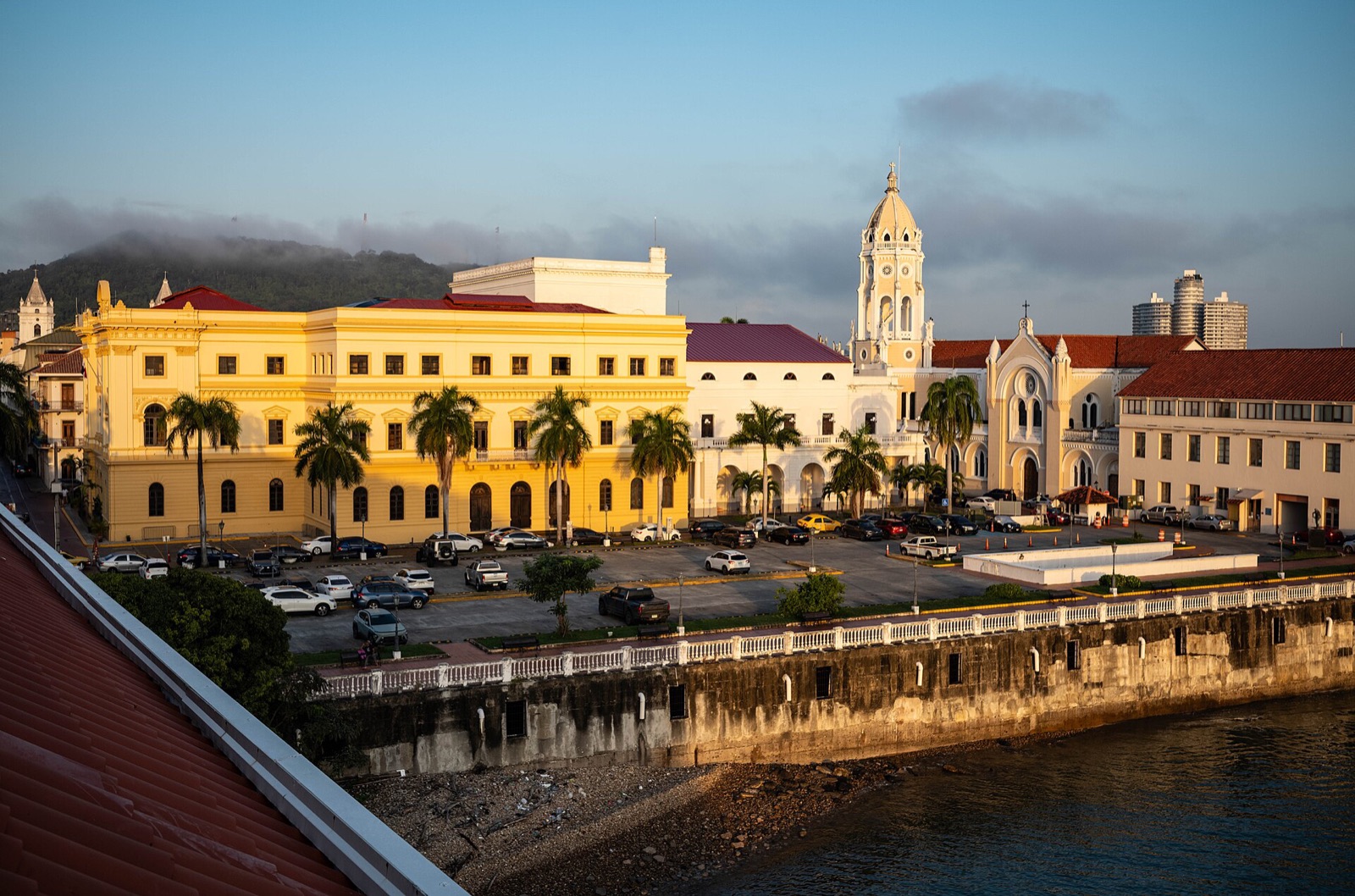
Casco Viejo, Panama City, where the Carnival parade runs along the nearby Cinta Costera. Photo : RB Photo, Wikimedia Commons, CC BY 2.0.

For what is on in the capital through the year, see Panama City events.
Where to stay, by season
Match the property to the window rather than the other way round. A February trip and a September trip should not book the same coast.
- American Trade Hotel, Casco Viejo. A restored 1917 building on Plaza Herrera, in the quarter you walk rather than drive. Best in the dry season, when the old town is at its most usable on foot.
- The Santa María, a Luxury Collection Hotel and Golf Resort, Panama City. A Nicklaus course and a city base in one, which only makes sense between December and April.
- Punta Caracol Acqua Lodge, Bocas del Toro. Overwater cabins off Isla Colón, reached by boat. Aim for February, March or September, the archipelago's own dry windows.
- Hotel Panamonte, Boquete. A 1914 inn in the Chiriquí highlands, with fireplaces that earn their keep on 63 F nights. Strongest from January to March, at the end of the coffee harvest.
- Villa Condesa del Mar, Contadora, Pearl Islands. A short flight or ferry from Panama City and the closest base to the July to October humpback grounds.
- Bocas del Mar, Boca Chica, Chiriquí. The mainland jumping-off point for the Gulf of Chiriquí and Coiba, and a whale-season address as much as a diving one.
A wider view of where each province makes sense: where to stay in Panama, province by province.
FAQ
What is the best month to visit Panama?
February is the best single month to visit Panama. Panama City averages 0.4 in (9 mm) of rain across just 2.4 rainy days, with highs of 86 F (30 C). It is also the driest month in the Boquete highlands at 2.2 in (56 mm). The one caveat is Carnival, which falls in February and books out Las Tablas and Panama City months ahead.
What is the rainiest month in Panama?
It depends which coast you mean, and that is the point. On the Pacific, July is wettest in Panama City at 11.7 in (298 mm), with November close behind at 11.1 in (282 mm). On the Caribbean, November is wettest in Bocas del Toro at 15.7 in (400 mm). In the Boquete highlands the peak is October at 20.8 in (528 mm).
When is the rainy season in Panama?
The rainy season, called invierno locally, runs from roughly mid-April to mid-December on the Pacific side and in Panama City. It rarely rains all day: mornings are often clear and the heaviest rain falls in the afternoon. The Caribbean coast does not follow this pattern and sees rain in every month, with a drier spell in February, March and September.
What is the cheapest time to travel to Panama?
The green season, May to November, is the cheapest time to travel to Panama, with May, June and September the best value of all. Rates and airfares fall once the dry season ends. The exception is November, when five national holidays fill domestic travel and hotels in the Azuero Peninsula and the highlands.
Is October a good time to go to Panama?
October is the weakest month on Panama's Pacific side, with 29.9 rainy days and 10.4 in (264 mm) in Panama City, and the wettest month of the year in the Boquete highlands. It works if you reorganise the trip around the Caribbean and early October, when Bocas del Toro is coming off its September low of 7.8 in (197 mm). Expect the lowest rates of the year.
Is November a good time to visit Panama?
November is a difficult month on both coasts. It is the wettest month of the year in Bocas del Toro at 15.7 in (400 mm) and near the annual peak in Panama City at 11.1 in (282 mm). It also carries five national holidays, so domestic travel and parades add crowds to the rain. December is the better choice if your dates are flexible.
Does Panama get hurricanes?
No. Panama lies between roughly 7 and 9 degrees north, too close to the equator for tropical cyclones to form or track, and it is the one Central American country outside the hurricane belt. Neighbouring storms can still push heavy rain and swell onto the Caribbean coast, but Panama carries no hurricane season of its own, which is why it stays open when the rest of the region closes.
Do you need $500 to enter Panama?
United States citizens do not need a visa for tourist stays of up to 180 days, but immigration officers may ask for proof of onward travel and proof of funds, commonly cited as US$500 in cash, a bank statement or a credit card. A passport valid for at least three months beyond entry is required. Panama uses the US dollar alongside the balboa, pegged one to one, so no currency exchange is needed.